
Moving water away before it becomes an expensive problem.
Standing water doesn’t just make a yard look bad. Left alone, it migrates toward foundations, drowns landscaping, breeds mosquitoes, and turns into a recurring problem that costs more every season. A well-built French drain intercepts that water and carries it away before it ever gets the chance.
French drains are especially common on Northern California foothill properties, where sloped terrain, clay soils, and concentrated seasonal rainfall create drainage problems that surface again and again. CCS builds them to work for the long haul — because the details that make them last are exactly the ones most installers get wrong.
CCS provides French drain installation throughout Amador, Calaveras, El Dorado, Sacramento, and San Joaquin Counties.
Water that pools in the same spot after every rain isn’t random — it’s following the grade. On foothill properties, sloped terrain concentrates runoff into low points, while clay soils slow how fast that water can soak in, so it sits on the surface or pushes toward whatever’s lowest, often a foundation, a basement, or a crawl space.
Treating the symptom — regrading a soggy patch, adding gravel, hoping the next season is drier — rarely fixes anything, because the water is still arriving from the same source. It just resurfaces somewhere new.
Before we design anything, we trace where the water is actually coming from: surface runoff from higher ground, a downspout discharging too close to the house, a high water table, or water trapped behind a retaining wall.
Our team evaluates the source before recommending a drainage solution. We commonly trace water collecting around foundations, constantly wet lawns and landscape beds, erosion on sloped properties, crawl space and basement moisture, runoff crossing driveways and walkways, and drainage trapped behind retaining walls.
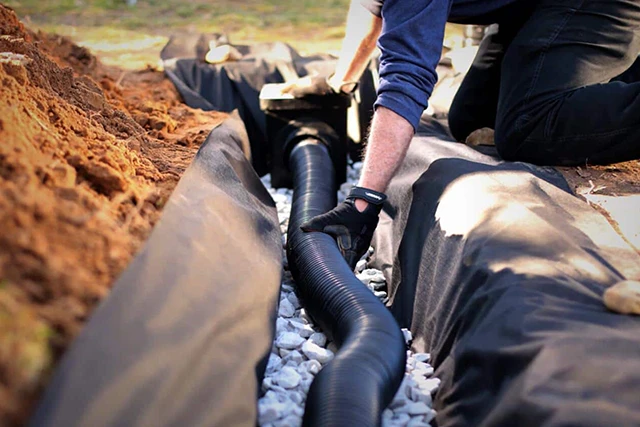
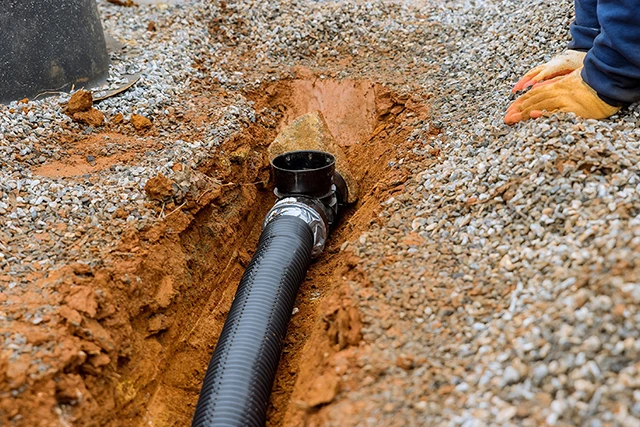
Once we know where the water is coming from, the system is built to intercept it and carry it to a real outlet:
Most French drain failures trace back to one of the same handful of shortcuts:
PROFESSIONAL INSIGHT
A French drain cannot compensate for poor grading. If the surrounding ground slopes toward the building, installing a drain without correcting the grade often provides only temporary relief. We look at the grade first — the drain is the second half of the solution, not the whole of it.
A correctly built French drain — proper slope, washed rock, geotextile-wrapped pipe, and a real outlet — should work for decades with minimal upkeep. Most early failures come from skipping one of those elements during installation rather than from anything wearing out later.
We also tie French drains into surface grading and downspouts where it helps, so the subsurface system isn’t fighting surface water that could have been routed away in the first place.
Built correctly — proper slope, washed rock, geotextile-wrapped pipe, and a real outlet — it should work for decades. Most early failures come from skipping one of those.
Usually, if it intercepts the water before it reaches the foundation and routes it to a proper outlet — and if the grade is corrected too.
Washed rock lets water into the pipe freely; the geotextile fabric keeps soil from clogging the rock and pipe. Both are essential to longevity.
Yes — it can be integrated with downspouts and surface grading as part of a complete drainage plan.
Almost always silt clogging from missing or wrong fabric, too little slope, or no real outlet. We rebuild it to drain properly.
Fighting a Water Problem?
If water is pooling where it shouldn’t, CCS will trace the source and build subsurface drainage that lasts. Contact us to assess your property.
Related Services
Building Pads , Bollards , Encroachments
From site preparation to final construction, we create strong homes, business spaces, and property upgrades built for lasting value.
2026 © Comprehensive Construction Services website Developed & Powered by MYAIO


