
Every trench on a construction project represents time, labor, equipment, inspections, and restoration costs. When power, gas, and communications are installed separately, those costs multiply quickly.
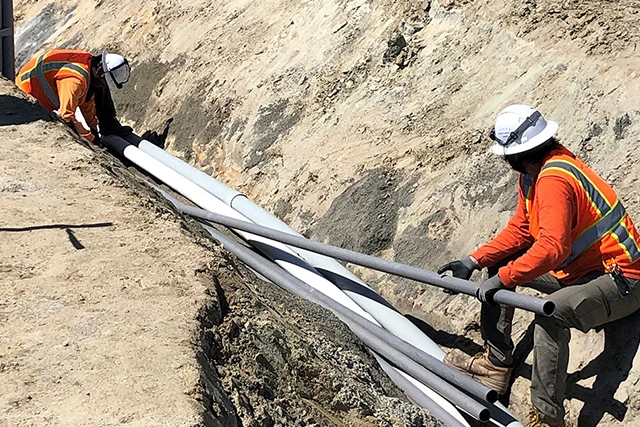
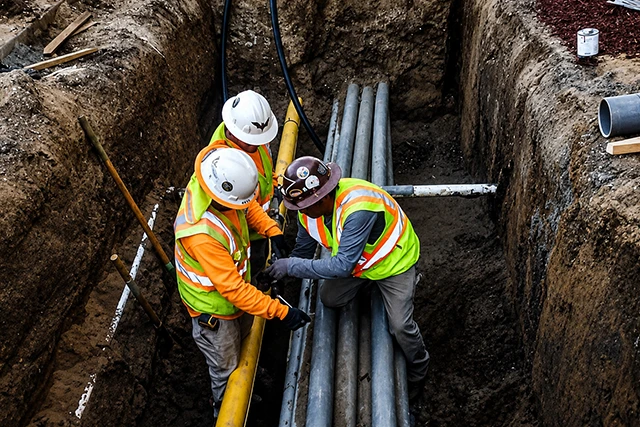
Joint trenching combines compatible utilities into one carefully planned corridor, reducing excavation, minimizing site disturbance, and improving project coordination. The savings don’t come from digging faster—they come from digging once.
CCS plans and constructs joint trench systems throughout Amador, Calaveras, El Dorado, Sacramento, and San Joaquin Counties, coordinating utility providers and installation requirements from design through final inspection.
Many property owners assume the biggest expense is installing the utility itself. In reality, excavation often becomes one of the largest costs on a project.
Joint trenching helps reduce these repeated activities by placing compatible utilities within one coordinated trench while maintaining the required separations and clearances established by utility providers and local jurisdictions.
Not every utility can occupy the same space, but many dry utilities can safely share a properly designed trench when installation standards are followed.
Each utility maintains its required depth, separation distance, warning tape, tracer wire, and inspection procedures.
Planning these requirements before excavation begins helps prevent conflicts later in construction.
Rather than treating excavation as an isolated task, we coordinate the entire utility installation process to keep the project moving efficiently.
It is particularly valuable where paving, sidewalks, landscaping, or finished surfaces would otherwise need to be disturbed multiple times.
The success of a joint trench is determined long before excavation equipment arrives.
Proper coordination at this stage helps reduce construction delays while minimizing the risk of failed inspections or unnecessary re-excavation.
We review project drawings, confirm participating utility providers, and identify which services can share a common trench.
The trench is designed around required depths, separations, and future accessibility while considering site grading and drainage.
Each provider installs their system according to the planned sequence, allowing work to progress efficiently without interfering with other utilities.
After inspections are complete, the trench is backfilled and compacted in controlled lifts to provide long-term stability.
One incorrectly placed conduit can require an entire trench to be reopened after inspection.
Joint trenching is successful because of planning—not because multiple utilities happen to fit into one excavation. Proper layout, provider coordination, and inspection scheduling protect both the construction schedule and the project budget.
Property owners, developers, and general contractors choose CCS because we understand that joint trenching is primarily a coordination project.
By managing both the engineering and construction aspects of the work, we help reduce delays while keeping utility installation organized.
Electrical, gas, telecommunications, fiber optic, and similar dry utilities are commonly installed in joint trenches when local requirements allow. Water and sewer typically have separate installation standards.
Yes. Most savings come from reducing excavation, inspections, restoration work, and construction time rather than reducing utility installation itself.
CCS works with utility providers, engineers, inspectors, and contractors to organize installation sequencing and keep the project moving.
Yes. Trench design, shoring, grading, and utility depths are adjusted to accommodate changing terrain while maintaining required cover and separation distances.
Yes. We install conduit systems, tracer wire, duct banks, and related underground infrastructure according to project specifications and utility requirements.
From site preparation to final construction, we create strong homes, business spaces, and property upgrades built for lasting value.
2026 © Comprehensive Construction Services website Developed & Powered by MYAIO


