
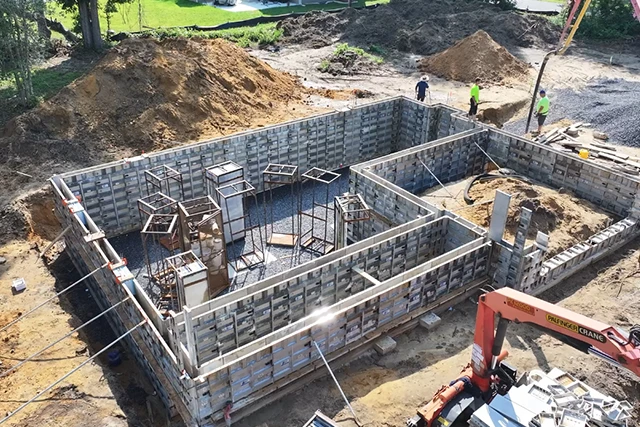

Most foundation problems aren’t visible for years. By the time you notice a crack, the real cause has often been there since the concrete was poured.
Every structure depends on the strength of what lies beneath it. Soil conditions, drainage, slope, and structural loads all affect how a foundation performs over time. At CCS, we don’t rely on one-size-fits-all foundation designs. Every project is planned around the conditions of the specific site, helping reduce future settlement, cracking, and moisture problems.
As a licensed General Engineering (Class A) and General Building (Class B) contractor, CCS designs and constructs foundation systems for residential, commercial, and industrial projects throughout Northern California.
Clay soils expand and contract with changing moisture levels. Sandy soils drain quickly but may settle differently over time. Sloped lots introduce additional structural challenges, while poor drainage can place unnecessary stress on a foundation.
Before construction begins, CCS evaluates site conditions to understand how the ground is expected to perform—not just during construction, but for years after the building is complete.
Every project has different structural and site requirements.
A practical option for flat, stable sites where efficiency and construction speed are priorities.
Ideal for sloped properties or buildings requiring easier access to plumbing, electrical, and mechanical systems beneath the floor.
Commonly used for multi-story residential and commercial construction requiring greater structural capacity.
Designed to perform better on expansive clay soils commonly found throughout many California regions by helping reduce movement-related cracking.
Typically used for industrial facilities, heavy structures, and projects requiring load transfer to deeper bearing soils.
Choosing the appropriate system depends on the property’s soil conditions, drainage, structural loads, and engineering requirements.
Many long-term foundation issues begin during the planning stage rather than after construction.
Addressing these issues early helps improve long-term structural performance.
Every foundation project follows a carefully coordinated process.
We review soil conditions, drainage patterns, grading, and project requirements.
Foundation layout is coordinated with building pads, utilities, and structural plans.
Excavation, formwork, reinforcement, and vapor barriers are installed according to project specifications.
Concrete is placed under controlled conditions before required inspections are completed and the project moves to the next phase.
A foundation doesn’t perform independently. Site grading affects drainage, building pad compaction influences long-term stability, and underground utility placement impacts foundation construction.
Because CCS manages both General Engineering and General Building work, these phases are coordinated together instead of being divided between multiple contractors. That integrated approach helps reduce scheduling delays, improve quality control, and support better long-term performance.
The appropriate foundation depends on soil conditions, drainage, structural loads, and the type of building being constructed.
Yes. We construct foundation systems for residential, commercial, industrial, and municipal projects.
Different soil types behave differently over time. Understanding those conditions helps determine the most suitable foundation design.
Yes. Water collecting around a foundation can contribute to settlement, erosion, and long-term structural issues if it isn't properly managed.
Yes. Building pad preparation, grading, underground utilities, and foundation construction are planned together whenever possible.
Absolutely. We provide foundation construction for new homes, additions, remodels, commercial buildings, and industrial facilities.
From site preparation to final construction, we create strong homes, business spaces, and property upgrades built for lasting value.
2026 © Comprehensive Construction Services website Developed & Powered by MYAIO


